Fits Like a Mitten: Where the Hand Map Came From, and a Field Guide to How Michigan Talks
Michigan was 'the Thumb of the Michigan Mitten' by 1880 and 'the Mitten State' by 1901. How the hand map got here, and what we really mean by pop, ope, fudgie and Meijer's.
- Published
- Read
- 6 min
- Comments
- Be the first to comment
In this story
Put a Michigander anywhere in the world and ask them where they’re from, and they won’t reach for their phone.
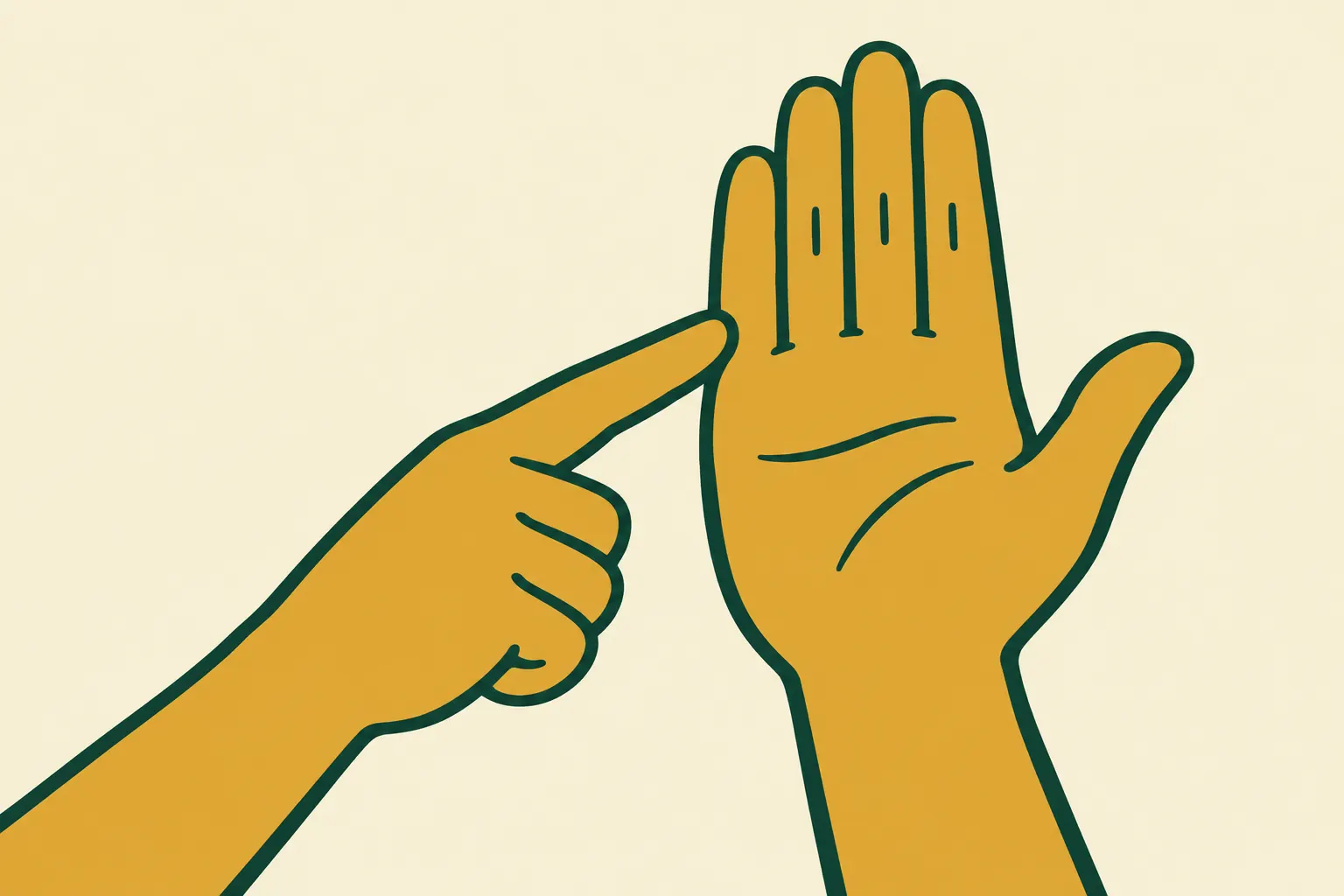
Instead, they’ll raise their right hand, palm facing them, fingers held tight together with the thumb cocked outward like an oven mitt. With the index finger of the other hand, they’ll tap a knuckle or press into the center of the palm:
“Right here. About forty-five minutes north of Grand Rapids.” or “Right out here on the pinky nail.”
Other places have tried hand maps, but no state gets more practical use out of its own anatomy. Wisconsin’s tourism department put a mitten in its campaign in 2011, and Michigan’s tourism office answered: “We understand their mitten envy. But there is only one mitten state.”
Yet early historical maps of North America didn’t show a recognizable mitten. Here’s what the paper trail actually shows about how our shape was mapped, when we became “the Mitten,” and an unofficial field guide to the native dialect of the people who live inside it.
From Arrowhead to Mitten: Early Cartography
The Lower Peninsula didn’t arrive on early maps looking like something you slip into before shoveling the driveway.
In 1718, French cartographer Guillaume de L’Isle published his “Carte de la Louisiane et du cours du Mississipi”, a sweeping map of the Mississippi basin that caught the Great Lakes along its upper edge. On his map, the Lower Peninsula looked, as Michigan Radio put it, like “an arrowhead or like a weird parallelogram.”
By the 1830s, when surveyor-turned-territorial delegate Lucius Lyon was petitioning Congress for statehood, better compass surveys gave Michigan a more recognizable shape, though one mid-1800s map still made the state look like “an open-mouthed shark.”
Better surveys through the mid-1800s sharpened the shape, and by 1880 people were already calling the Thumb (Huron, Tuscola and Sanilac counties) “the Thumb of the Michigan Mitten.”
The Paper Trail: Who First Said “Mitten”?
It’s easy to assume Michigan’s mitten nickname was a tourism-bureau slogan, but print archives show the mitten was part of everyday speech by the 1880s:
- 1880: In Rowell’s American Newspaper Directory, a Tuscola County newspaper pitch described its local readers as living in “what is known as ‘The Thumb of the Michigan Mitten.'”
- 1881: Harper’s Weekly described the Thumb, between Saginaw Bay and Lake Huron, as what “the people of the State, with their rude figures of speech, call the ‘Thumb of the Mitten.'”
- 1891: A Lippincott encyclopedia article on Michigan geography explicitly referred to the Huron Peninsula as forming “the ‘thumb’ of the ‘mitten.'”
- 1901: Silas Farmer’s The Michigan Book: A State Cyclopedia formally recorded the nickname: “The Mitten State, from the general resemblance of the outline of the lower peninsula to a huge mitten.”
What About the Upper Peninsula?
Yoopers, naturally, have their own anatomical addition.
If you turn your left hand sideways above the right, thumb up for the Keweenaw and fingers pointed east toward Drummond Island, you get the Upper Peninsula. If you squint, it resembles a rabbit hopping along Lake Superior’s south shore.
An Unofficial Field Guide to Michigan Speech
Because Michigan was settled by a mix of New England Yankees, German and Polish tradespeople, Cornish miners, French-Canadian timber cruisers and Scandinavian loggers, we talk in a way that’s distinctly our own. It’s part Inland North vowel shift that we share with Chicago and Buffalo, and part vocabulary you’ll rarely hear anywhere else.
Borrowing from what University of Michigan linguist Anne Curzan has told Michigan Radio over the years, here’s an unofficial field guide:
1. The Possessive “S”
Michiganders regularly add an “s” to commercial business names:
- “I gotta run to Meijer’s to grab milk.” (Hendrik Meijer opened the first one in Greenville in 1934, so he gets the apostrophe).
- “My grandfather worked at Ford’s.”
- “We stopped at Kroger’s before heading to the Secretary of State.” (Saying “DMV” in Michigan will immediately identify you as an out-of-stater).
2. “Ope”
The involuntary reflex sound of the Great Lakes basin. Deployed when you bump into someone at a grocery store, drop a wrench or squeeze down a crowded hallway.
- Usage: “Ope, sorry about that, just gonna squeeze past ya.”
- Origin: Nobody knows with certainty. MSU linguist Betsy Sneller points out that common theories like a Norwegian borrowing don’t hold up (“there’s not a word in Norwegian that is ‘ope'”), and doubts it’s simply a worn-down version of “oops.”
3. Pop
In Michigan, carbonated soft drinks are pop. About two out of three of us use the term, according to regional dialect surveys.
The word itself has English roots (in 1812, poet Robert Southey wrote that it was “called pop because pop goes the cork when it is drawn”), but Detroit gave it a permanent home. James Vernor first served his ginger ale in Detroit in 1866, by the company’s account, and Russian-immigrant bakers Ben and Perry Feigenson started the bottling works in Detroit in 1907 that became Faygo.
4. Yoopers vs. Trolls
The geopolitical division of Michigan, made possible on Nov. 1, 1957, when the Mackinac Bridge opened:
- Yooper: A resident of the Upper Peninsula (U.P. → U.P.-er → Yooper), officially added to the Merriam-Webster Collegiate Dictionary in 2014.
- Troll: Anyone residing in the Lower Peninsula, because you live under the bridge. There are nearly 10 million trolls in Michigan compared with roughly 300,000 Yoopers, and Yoopers never let us forget it.
5. Fudgie
- Definition: A summer tourist who visits northern Michigan resort towns and buys fudge.
- Etymology: Born on Mackinac Island in the 1960s as fudge shops kept popping up, the label now covers anyone carrying a white candy box down the sidewalks of Mackinaw City or Petoskey.
6. “Up North”
To an outsider, “up north” is a simple direction. To a Michigander, Up North is a proper noun, an emotional retreat and a destination. You never say you’re going “to the north”; you say you’re “heading Up North.” (And as Curzan notes, in Michigan parlance, “up north” refers to northern Lower Michigan, while the Upper Peninsula is simply “the U.P.”).
Michigan Vocabulary at a Glance
| What We Say | What Outsiders Say | What It Means in Practice |
|---|---|---|
| “Ope!” | “Pardon me” | The reflex sound of a polite physical encounter |
| “Pop” | “Soda” | Carbonated soft drink |
| “Meijer’s” | “Meijer” | A supercenter the size of a few football fields, with everything you need |
| “Troll” | “Lower Peninsula resident” | Someone who lives south of the Mackinac Bridge |
| “Up North” | “Heading north” | Where your shoulders drop and the pines begin |
Why It Fits Like a Mitten
The mitten was in print by 1880, while the hand gesture is older than anyone wrote down.
Michigan isn’t just a place where you live. It’s something you carry with you in your vocabulary and in the map on your hand. When something is honest, comfortable and made to weather the seasons, we don’t say it’s fine.
We say it fits like a mitten.
The first Fits Like A Mitten tees are on the way. Join the list to hear the day the founding drop opens.

Pass it along
Send this digital postcard to a friend.
We’ll email them the card, your note and a link to the story. No stamp needed, and nobody gets added to a list.



Comments