The Petoskey Stone, Honestly: 350 Million Years, a 25-Pound Limit, and a Confiscated 93-Pound Fossil
Michigan's state stone is a coral reef more than 350 million years old. Here's how to spot one, where you can legally keep it and how a 93-pound Petoskey ended up in Detroit.
- Published
- Read
- 6 min
- Comments
- Be the first to comment
In this story
Walking the cobble shoreline of Little Traverse Bay between Magnus Park and Petoskey State Park on an August morning, you’ll see a posture known locally as the “Petoskey Stoop.”
Hips bent, shoulders slouched, eyes scanning the wet breakline where the waves wash over the gray gravel. Every few seconds, someone reaches down, splashes a pebble with lake water, sighs and tosses it back.
Finding a good one is harder than gift shops make it look. Understanding what it is, where you can legally keep it and how a 93-pound boulder ended up in state custody takes a little more history.
What It Actually Is: A Tropical Reef Near the Equator
To understand why this gray rock exists on a freshwater beach in Emmet County, you have to rewind more than 350 million years. Geologists date these corals to the Middle Devonian Period, roughly 380 to 390 million years ago, long before dinosaurs or the Great Lakes.
At that time, the landmass that became Michigan sat in the tropics, a bit south of the equator, submerged beneath a shallow, warm tropical sea that filled what geologists call the Michigan Basin. That sea was teeming with life: corals, crinoids, trilobites, brachiopods and early fish.
The scientific name for the Petoskey stone coral is Hexagonaria percarinata.
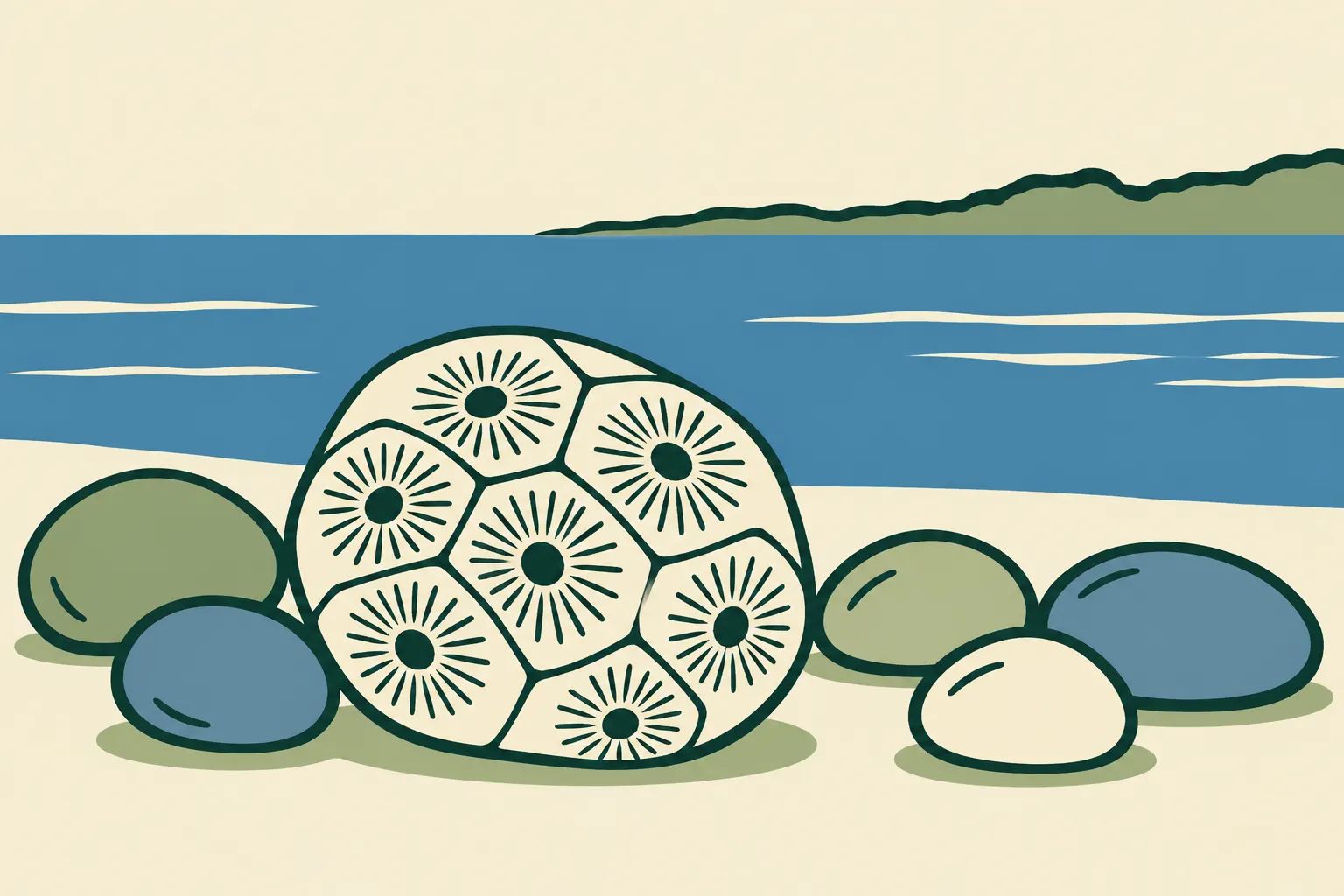
Each stone is a fossilized colony of ancient organisms. When the coral was alive, each six-sided cell housed an individual polyp waving tentacles to feed on passing plankton. The delicate lines radiating from the center like bicycle spokes are calcite septa that supported the coral’s soft tissue.
Over millions of years, calcium carbonate sediments locked the colonial reefs into dense beds of limestone known as the Traverse Group (specifically the Gravel Point Formation). Much later, Pleistocene ice sheets ground across the Lower Peninsula, plucking chunks of fossilized bedrock, tumbling them smooth and scattering them across northern Michigan as rounded cobblestones.
The 25-Pound Limit and the Copemish Stone
In September 2015, a Copemish man named Tim O’Brien was walking the shallows of Lake Michigan near Northport, out near the tip of the Leelanau Peninsula. In the water, he spotted a 93-pound Petoskey stone and worked it out of the lake bottom with a trowel. Most Petoskey stones weigh a few ounces.
O’Brien got the boulder to shore and took it home to Copemish, planning to display it on his lawn.
Word spread quickly through local media. The Michigan Department of Natural Resources took notice, and by December conservation officers had collected the stone from his home.
O’Brien had unknowingly run up against Michigan’s 25-pound rule.
Under the Michigan DNR’s State Land Rules:
- You may collect rocks, minerals and invertebrate fossils (including Petoskey stones) on state-owned land and Great Lakes bottomlands for personal, noncommercial use.
- The limit is 25 pounds per person per year, all trips combined.
- Any single stone weighing over 25 pounds exceeds your entire annual allowance in one find.
Because the stone came off state-owned Great Lakes bottomland and weighed 68 pounds over the legal limit, the state seized it. In 2017, the DNR announced it would put the stone on permanent display at its Outdoor Adventure Center in Detroit.
State Land vs. Federal Land: Where You Can Legally Pick
Plenty of well-meaning beachcombers run afoul of the law simply because they don’t know whose land they’re standing on.
| Jurisdiction | Legal Collecting Limit | Penalty for Violations |
|---|---|---|
| State Parks & State Land (e.g., Petoskey State Park, Fisherman’s Island) | 25 lbs / person / year (combined) | Confiscation, civil fine up to $500 |
| Great Lakes Bottomlands (state-owned, public trust) | 25 lbs / person / year (combined) | Confiscation, civil infraction |
| Sleeping Bear Dunes National Lakeshore (NPS) | 0 lbs (Strictly prohibited) | Federal citation |
| Private Land (Above ordinary high-water mark) | Landowner permission required | Trespass |
If you’re on the beach at Petoskey State Park or Fisherman’s Island State Park, you’re on state land, where the 25-pound annual allowance applies.
However, inside Sleeping Bear Dunes National Lakeshore — stretching from Platte Bay north past Empire, Glen Haven and Good Harbor, as well as North and South Manitou Islands — federal law applies.
Under 36 CFR § 2.1, it is strictly prohibited to be “Possessing, destroying, injuring, defacing, removing, digging, or disturbing from its natural state” any paleontological specimens or mineral resources. That means zero pounds: leave every pebble, fossil and handful of sand where you find it. National Park Service rangers enforce the regulation, and a federal citation costs far more than any gift-shop souvenir.
How to Spot a Real Petoskey Stone
Before bringing your beach finds home, keep these identification tips in mind:
The Wet vs. Dry Check
When completely dry, a Petoskey stone looks like any other dusty gray limestone pebble along the shore. Its fossil pattern is often faint or hidden.
Dunk the stone in the water or wet it with your thumb. The water reveals the structure beneath: if you see distinct six-sided corallites with spoke-like lines radiating around a central dark eye, you’ve found one.
Petoskey vs. Charlevoix Stones
Rockhounds frequently encounter the Charlevoix Stone (Favosites), another common Devonian fossil coral:
- Petoskey Stone (Hexagonaria percarinata): Features larger, distinct hexagonal cells with radiating spoke lines (septa) surrounding a central dark spot.
- Charlevoix Stone (Favosites): Commonly called “honeycomb coral.” It has much smaller, tightly packed polygonal tubes without radiating spokes.
Real Fossils vs. Imported Corals
Some polished “Petoskeys” sold online are actually other fossil corals from overseas, and a vinegar test won’t tell them apart since both are calcite. If it matters to you, buy from a reputable Michigan shop. (On your own beach finds, a drop of vinegar on an unpolished spot may raise a faint fizz; never test a polished face, as vinegar can etch and dull the surface.)
How to Polish a Petoskey Stone by Hand
Petoskey stone is soft calcite with a Mohs hardness of roughly 3. Loading raw Petoskey stones into a mechanical rock tumbler with harder quartz or agates can quickly wear down the soft fossil matrix and blur the pattern.
Many northern Michigan collectors polish their stones by hand:
- Start with 220-grit wet sandpaper: Rub the stone in small circular patterns on a flat, wet surface until all rough pits and scratches disappear. Keep the stone wet while working. Expect the 220-grit stage to take the longest.
- Move to 400-grit, then 600-grit wet sandpaper: Once the stone feels smooth at 600 grit, keep going another 5 to 10 minutes until it feels as slick as a bar of soap.
- Buff with polishing compound: Sprinkle a small amount of aluminum oxide polishing powder on a piece of damp corduroy or velvet. Rub firmly in short circular strokes until the pattern takes on a clean, glass-like luster.
With a little patience, the Middle Devonian coral pattern will stand out clearly, showing the detailed colonies that lived in Michigan’s ancient seas.
The first Fits Like A Mitten tees are on the way. Join the list to hear the day the founding drop opens.

Pass it along
Send this digital postcard to a friend.
We’ll email them the card, your note and a link to the story. No stamp needed, and nobody gets added to a list.


Comments