What Happened to Larks Lake, and What Would It Take to Bring It Back?
Larks Lake is shallow, spring-fed and clean, but swimmer's itch keeps us out of the water. Moving merganser ducklings worked until federal permits were canceled in 2025. Here's what it would take to bring the lake back to its former glory.
- Published
- Read
- 12 min
- Comments
- Be the first to comment
In this story
In 1915, a pioneer association formed at Round Lake — the lake we know today as Larks — to preserve the natural beauty of the grounds for posterity and as a memorial to the settlers of northern Emmet County.
Until 1932, it held an annual picnic with singing, speeches, contests and recollections of early days. In 1950, the association deeded the park to Emmet County.
That shore has belonged to us ever since.
The picnic grounds were designated a Michigan State Historic Site in 1971, and down on West Van Road, Moose Jaw Junction traces its tavern roots back to 1946, when it opened as the Round Lake Bar and Larks Lake Bar.
But while Emmet County’s 2023–2027 Parks and Recreation Master Plan still lists Lark’s Lake Pioneer Park on Latocha Road among the county’s public swimming beaches, it has long ceased to be the community gathering place it once was.
You can chalk that up almost entirely to swimmer’s itch — the result of a microscopic parasite that has turned one of the friendliest swimming lakes in northern Michigan into a summer hazard.
In our view, swimming in lakes like Larks is a birthright of growing up Up North, handed down across generations. Getting back in the water will take help from Lansing and Washington, because the birds carrying the parasite cross state lines and the implementing the remediation measures required to permanently solve the problem takes more than a small lake association can manage on its own.
The Lake Itself: Shallow and Spring-Fed
When a lake gets a reputation for rashes, a lot of us assume septic tanks or runoff are to blame. With Larks Lake, the evidence points elsewhere.
Larks is a spring-fed marl lake covering 592 acres, according to the Little Traverse Bay Bands of Odawa Indians Natural Resources Department. The Tip of the Mitt Watershed Council notes that the basin sits in Center Township in northern Emmet County, draining a watershed of 4,640 acres as the headwaters of Brush Creek, which runs to the Maple River, Burt Lake, the Cheboygan River, and Lake Huron.
It’s also remarkably shallow. In its 2022 Larks Lake Shoreline Survey Report, Tip of the Mitt pointed out that along four miles of shoreline, the water is nowhere deeper than nine feet. About a quarter of the shore is state-owned land, and more than sixty percent remains undeveloped, with public access at Center Township Park and the Kaz Road launch.
The shoreline shows no sign of nutrient pollution. Tip of the Mitt’s 2022 survey found no Cladophora anywhere along the shore — an improvement from light growth at three parcels in 2006 — and its monitoring shows nitrogen and phosphorus declining overall since 1998.
What’s Actually Biting Us: A Duck, a Snail, and a Worm
Swimmer’s itch isn’t an infection you catch from someone else, and it isn’t caused by duck droppings on your skin.
According to the Centers for Disease Control and Prevention, it’s an allergic reaction to microscopic parasite larvae shed into fresh water by aquatic snails.
When these swimming larvae, called cercariae, bump into a wading human, they mistake us for waterfowl. They burrow into the skin, and because they can’t develop inside a person, they soon die.
The rash is an allergic reaction. Within 12 hours, small reddish pimples erupt, accompanied by burning and itching that can last a week or more. The CDC notes children get hit hardest because they spend more time wading in warm shallows where larvae drift, and rarely towel off right away.
In the northern Michigan lakes the researchers studied, the culprit is Trichobilharzia stagnicolae, an avian schistosome. As documented in a 2024 study in PLOS One by Curtis Blankespoor, Harvey Blankespoor and Randall DeJong, the parasite relies on two hosts: common mergansers (Mergus merganser) and freshwater snails (Stagnicola emarginata). Adult worms shed eggs in duck droppings, which hatch into swimming miracidia that infect snails. A single infected snail can release up to several thousand free-swimming cercariae a day.
Northern Michigan is the historical home of this research. As chronicled by Interlochen Public Radio’s Points North on Great Lakes Now, the cycle was first discovered in 1928 on Douglas Lake at the University of Michigan Biological Station near Pellston, by Dr. William W. Cort.
The ducklings are the engine. The 2025 Journal of Parasitology study found adult hens infected but passing low numbers of eggs, while older ducklings were all passing eggs.
As Alex Walters reported for Capital News Service and Bridge Michigan, ducklings can carry up to 50 times more parasites than adult ducks. The researchers say their results strongly suggest the parasite relies on each year’s hatch of ducklings to stay at high levels. The MISIP manual suggests avoiding early morning swims, staying clear of downwind shores, and toweling off vigorously, but personal prevention only goes so far on a round, shallow lake.
90 Years of Trying: From Copper Sulfate to Duck Traps
We’ve tried tackling swimmer’s itch for nearly a century — mostly with chemical treatments. In the summer of 1939, the Michigan Stream Control Commission began treating beaches with copper sulphate and copper carbonate to kill snails. A report by Leonard N. Allison for the Michigan Institute for Fisheries Research noted the treatment was “usually fatal to most bottom organisms,” even though game fish swam clear of treated zones.
For decades, lake associations used copper sulfate because they lacked alternatives. On Glen Lake, biologist Rob Karner was hired in 1980 to tackle the problem. As he recalled to Great Lakes Now, the association dumped copper sulfate in 1981, and the next year hired a crop duster to spray a doubled or tripled dose.
It cost $40,000, and Karner recalled telling the annual meeting: “We did our best. …and it didn’t work, and we gotta do something different.”
The 2024 PLOS One study noted copper sulfate is localized, temporary, and harmful to aquatic life. A 2019 study in the MISIP Manual confirmed that while it knocks down snails, it has no significant impact on parasites in the water.
In the early 1980s, biologists Harvey Blankespoor and Ron Reimink shifted toward managing the birds. Curtis Blankespoor told Capital News Service that “it took us 20 years to develop a trapping method to effectively capture these ducks.”
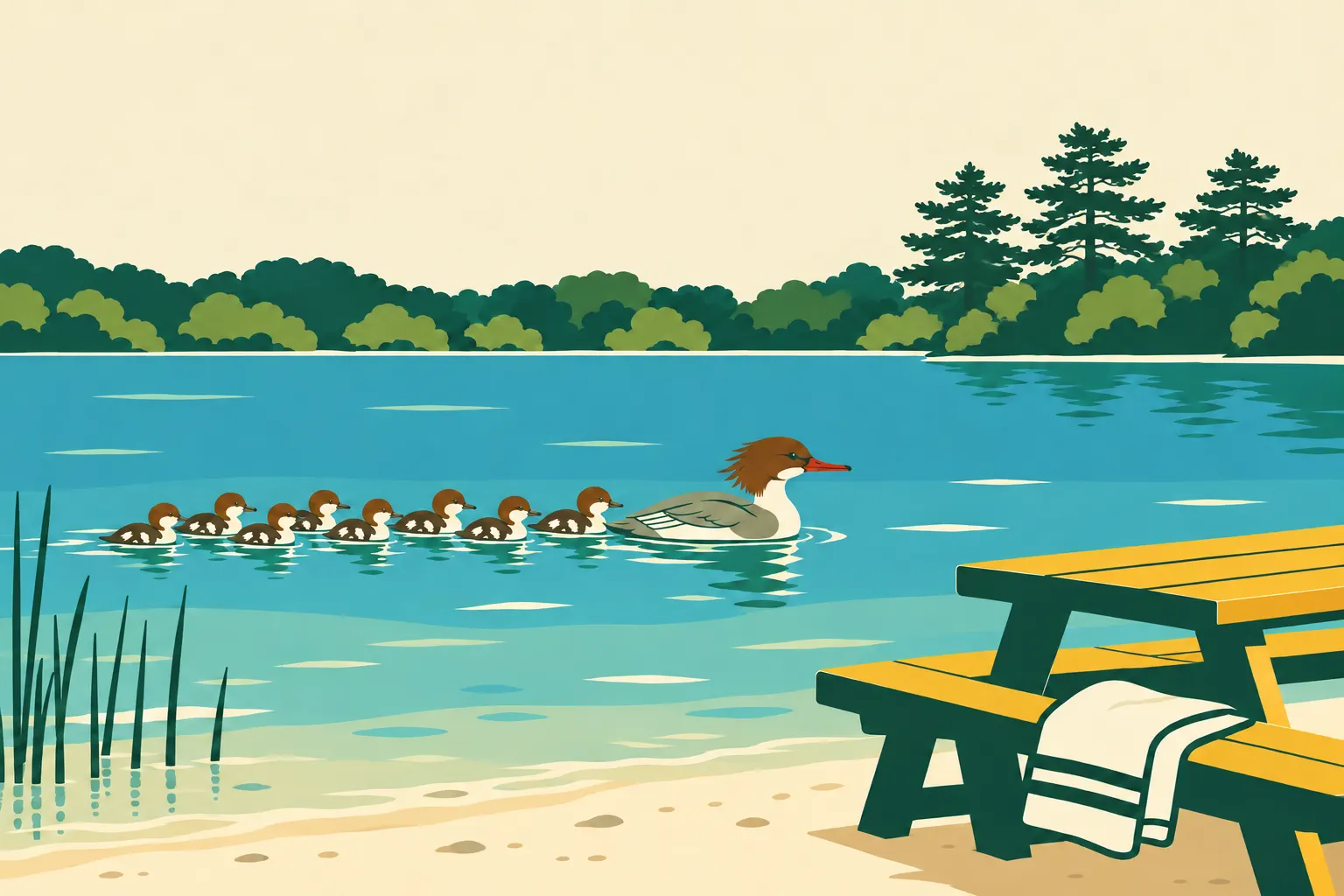
The solution was a large V-shaped net set near shore, where small boats herd broods into the corral. Captured ducklings are caged, banded, tested, and released at state-approved Lake Michigan and Lake Huron sites lacking the host snails. The DNR permitted a three-year study on Higgins Lake in 2015.
In 2018, Michigan’s Wildlife Conservation Order was amended to add a merganser control permit, and five lake associations got one.
Larks Lake’s Turn, and It Worked
Larks Lake jumped at the opportunity, joining Higgins, Crystal, Black, and Douglas lakes in testing brood relocation.
For Jeff Stratton, president of the Larks Lake Association in 2024 when interviewed by Capital News Service, the program changed everyday life.
Stratton had visited Larks Lake for 50 years, but the water began covering his legs in hundreds of itchy welts. “
It was horrible,” Stratton told CNS. “Crazy itchy. Crazy painful.” Four years of trapping and relocating ducklings to Great Lakes waters changed that, and by 2024 Stratton told reporters he could swim in Larks Lake again.
For a few summers, by Stratton’s account, it worked. Where relocation has been studied, the results are strong. A 2024 peer-reviewed study of Higgins Lake and Crystal Lake, by researchers who also run the trapping company (Swimmer’s Itch Solutions) found snail infection down more than 50-fold on Higgins and more than 10-fold on Crystal, holding infection near 0.05 percent while cases dropped substantially.
On Higgins Lake, snail infection fell from 3.01 percent in 2015 to 0.28 percent in 2016, a 90 percent drop documented by the Higgins Lake Property Owners Association.
On Crystal Lake, biologists reported in their 2026 Crystal Lake Report that relocation reduced cases by 69 percent per year.
Not every study agrees: a team led by Rudko found relocation on Big Glen Lake and North Lake Leelanau didn’t meaningfully reduce the parasite, a finding the Blankespoors dispute.
For 2024, Swimmer’s Itch Solutions planned to relocate every merganser brood on Larks Lake, asking residents to report sightings between June 1 and July 15 before ducklings began passing eggs.
Then the Permits Went Away (Status as of October 2026)
We found no public update specific to Larks Lake after 2024.
The program had hit pauses before. In 2022 and 2023, the Michigan DNR suspended relocation over highly pathogenic avian influenza (HPAI), warning wild bird transport could spread disease, as reported by 9&10 News.
When trapping resumed in 2024, Curtis Blankespoor told Capital News Service that the DNR now acknowledged mergansers are poor hosts for avian flu, while observing that parasites had surged during the hiatus.
Then came a full shutdown.
In mid-April 2025, federal wildlife authorities canceled all relocation permits across Michigan. The Higgins Lake Swimmer’s Itch Organization dated the U.S. Fish and Wildlife Service revocation to April 14, 2025, and a DNR spokesperson told Bridge Michigan that the federal government had intervened.
Trapping stopped on Larks, Douglas, Higgins, and Crystal lakes. In February 2025, hundreds of dead mergansers washed ashore in Chicago during a suspected avian flu die-off.
Without relocation, the itch returned fast. On Crystal Lake, where trapping stayed suspended through 2026, the Crystal Lake Watershed Association report showed the beach case rate climbed from 3.5 percent in 2025 to 6.7 percent in 2026 (510 cases among 7,616 swimmers).
On Higgins Lake, broods weren’t removed in four of five years leading into 2026. In an update dated June 30, 2026, the Higgins Lake Swimmer’s Itch Organization reported its removal application had been pending with USFWS since April 6 without definitive direction.
Higgins Lake’s group has also applied for a federal permit to treat captured mergansers with praziquantel, an anti-parasitic drug. As of HLSIO’s June 30, 2026 update, that application had been rejected, resubmitted and rejected again, and the group was still working through the Fish and Wildlife Service’s concerns.
Whether the drug works lake-wide hasn’t been settled (an older Michigan trial found it didn’t prevent swimmer’s itch), which is why we’d like to see it tested.
Representative Jack Bergman’s office sought updates from USFWS in May and June 2026, and Senator Elissa Slotkin’s office was contacted in late June, but HLSIO had not yet received a response.
Because common mergansers are protected under the federal Migratory Bird Treaty Act (50 CFR 10.13), local associations cannot touch the birds without federal approval.
What It Would Take to Bring Larks Lake Back
Larks Lake is worth protecting, and bringing it back takes leadership that small lakeside communities cannot provide alone. The lake itself is in good shape. Its 2022 shoreline survey found no sign of nutrient pollution, and its beach is public. What it needs is the merganser-snail cycle interrupted early each summer.
First, the U.S. Fish and Wildlife Service should replace open-ended freezes with clear rules. Biosecurity concerns around bird flu are real, but an indefinite pause leaves communities without guidance. USFWS should establish clear testing protocols so broods can be screened for avian flu prior to transport, or approve on-site medical trials with praziquantel to see if treating ducklings directly can disrupt the cycle without transport.
Second, Lansing needs to replace sporadic grants with steady funding. Michigan provided a one-time $250,000 appropriation under Public Act 107 of 2017, and Bridge Michigan reported MISIP helped secure $750,000 in one-time state money.
When one-time funds dry up, small associations get stranded. Higgins Lake’s association spends about $20,000 a year on the problem, raised partly through fundraising events. A small lake may not have that cushion.
With 10,899 inland lakes across Michigan, the state needs a standing program to assist small lakes. We’re making this case for the public beach on Latocha Road and the families, kids and day-trippers who swim there, not for lakefront property values, and we think state money for swimmer’s itch should go first to lakes where the public can get in the water.
Third, the state should fund lake-by-lake scientific diagnosis. Elk-Skegemog’s DNA testing traced its cercariae to two cycles, mergansers with one snail and Canada geese with another, and the worm counts leaned toward the goose cycle. Its newsletter noted Elk Lake has relatively few mergansers. That’s the case for testing each lake before spending money on a fix.
After Elk-Skegemog’s 2019 state reimbursement of about $8,000 dried up, its board voted on April 17, 2020 not to trap that summer, citing mixed results elsewhere, migrating birds it couldn’t trap, and a budget that couldn’t keep up.
State testing grants would make sure each lake knows which bird and snail species are driving its problem before spending a dime.
Biologist Patrick Hanington noted in Bridge Michigan that relocation isn’t a silver bullet and that larvae feed filter feeders, cautioning against disrupting predator birds. Those cautions are fair. Relocation leaves the mergansers alive and moves young broods to Great Lakes waters where the host snails are absent.
Keeping the Water Open
Whatever the permit picture, Larks Lake residents and visitors can report brood sightings to the Larks Lake Association and Swimmer’s Itch Solutions. Documenting when broods arrive and tracking cases gives the association and the researchers a record to work from.
We can also urge state and federal lawmakers to press USFWS for sensible testing rules.
When the pioneer association deeded the park to Emmet County in 1950, it left the rest of us a place on that shore. We just need Lansing and Washington to help us get back in the water.

Pass it along
Send this digital postcard to a friend.
We’ll email them the card, your note and a link to the story. No stamp needed, and nobody gets added to a list.



Comments