Why the Woods Up North Look the Way They Do: A Road-Trip History of the Pines
Those ruler-straight rows of red pine along Interstate 75 didn't plant themselves. Here's how the lumber boom and the CCC shaped the woods Up North, and where to stand under the pines that got missed.
- Published
- Read
- 6 min
- Comments
- Be the first to comment
In this story
When you drive north on Interstate 75 past Roscommon or cruise down M-72 toward Kalkaska, look out the passenger window into the woods.
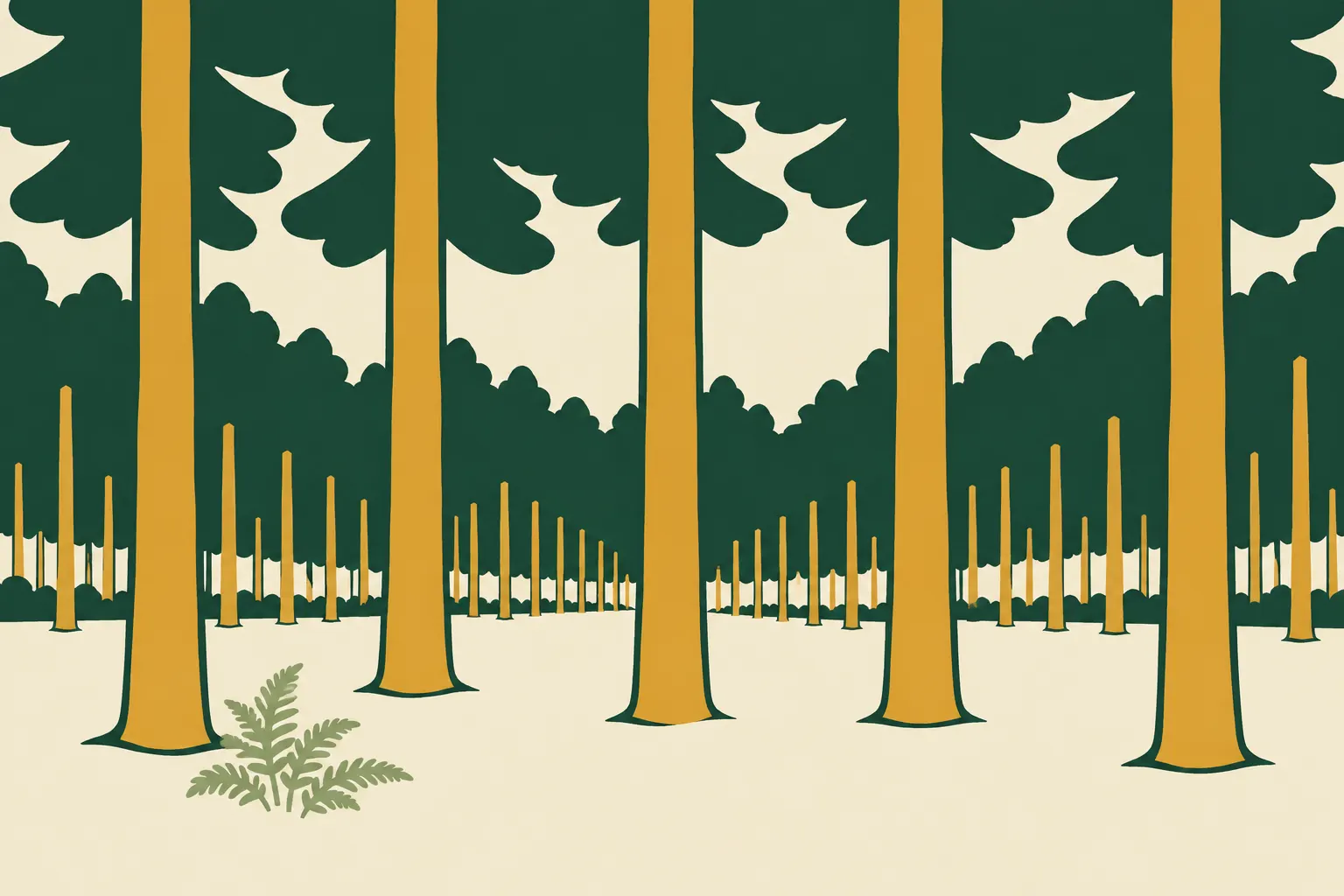
Instead of natural, random woodland growth, you see trunk after trunk of dark red pine planted in deliberate grid rows, marching over the sand ridges. As your tires hum against the asphalt, the gaps between the trunks create a rapid, rhythmic strobe effect in the sunlight.
Those rows reflect a 50-year timber boom, a period of devastating wildfires and an army of young men who helped reforest the state during the Great Depression.
Here’s the story behind why the woods Up North look the way they do, and where you can still walk among the trees that survived the axes.
The Green Gold Rush: When Michigan Timber Built the Midwest
For half a century, from the 1860s to about 1910, Michigan was one of the great lumber capitals of the country.
Before modern steel and concrete, white pine (Pinus strobus) was the primary building material of American growth. In the virgin forests of the northern Lower Peninsula, white pines grew to enormous dimensions: 150 feet and taller, more than 4 feet across at the base, and 350 to 400 years old. Their trunks rose straight and clear of branches for 80 feet or more. The wood was prized because it was lightweight, easy to work with hand tools and naturally buoyant in river log drives.
When the Great Chicago Fire leveled more than 3 square miles of the city in 1871, Michigan white pine helped rebuild it from the ashes. Michigan pine framed prairie farmhouses across the Midwest and built the factories of Detroit and Cleveland.
By the 1870s, well over a thousand sawmills were running across the state. In Muskegon, dozens of mills lined the lake, turning out hundreds of millions of board feet every season; locals called it the Lumber Queen of the World. Across the state, Saginaw’s riverfront was choked with log booms.
The men who did the cutting were often called “shanty boys.” They lived all winter in log bunkhouses deep in the woods, waking before dawn in sub-zero dark, eating flapjacks and salt pork, and felling giants with two-man crosscut saws known as “misery whips.”
Come spring, river drivers carrying spiked peavey poles rode the floating log drives down spring-swollen rivers like the Au Sable, Manistee, Boardman and Muskegon, risking their lives to break up dangerous river jams.
The Cutover and the Wildfires
The timber era was massive, but it was finite. Within 50 years, loggers cut nearly all of it.
By 1910, nearly all of the Lower Peninsula’s old-growth pine was gone. Millions of acres from Saginaw Bay to Traverse City were transformed into The Cutover — a landscape stripped down to stumps and thick layers of dry, resiny branches known as slashings.
In drought years, any stray spark — from a settler’s clearing fire, a locomotive or lightning — could ignite the slash.
The 1871 fires (which burned on the same dry October night as Chicago) and the Thumb Fire of 1881 burned millions of acres, killed hundreds of settlers and turned the noon sky yellow as far away as New England. The fires burned off the thin layer of organic forest soil, leaving the bare sand underneath to blow and wash away.
Land promoters bought up cutover tracts and marketed them as rich farmland to hopeful settlers, many of them recent European immigrants. Thousands of families moved north, cleared blackened stumps with dynamite and horse teams, and planted wheat and potatoes. But the thin, acidic glacial outwash soils couldn’t sustain row crops, and most settlers went broke.
Families abandoned their homesteads, and the State of Michigan ended up holding huge stretches of tax-reverted, burned-over sand plains.
FDR’s Tree Army: The CCC Replanting
In 1933, the federal government launched the Civilian Conservation Corps (CCC) to provide employment for young men during the Great Depression.
Stationed in military-style camps across northern Michigan, including the camp at Higgins Lake, these 17-to-23-year-olds lived in Army tents and later wooden barracks. They earned $30 a month, $25 of which was sent directly home to support their families.
Working 40-hour weeks through summer heat and autumn chill, the CCC crews plowed long, straight furrows across the sand plains. Working in teams, enrollees drove shovel-like tools called planting bars, or “dibbles,” into the soil, dropped bare-root seedlings into the slits, stomped the sand tight with their boots, took three steps forward, and repeated the motion.
They planted red pine (Pinus resinosa) and jack pine because those hardy species could take root in dry, nutrient-poor glacial sands.
By the time the program ended in 1942, the CCC had planted 484 million trees across Michigan — more than twice the amount of any other state in the country. Those straight rows of red pine flashing past your window on I-75 are the living legacy of those young men who helped rebuild Michigan’s forests.
The Survivor: Walking Among Giants at Hartwick Pines
If you want to see what Michigan looked like before the lumber boom, take Exit 259 off I-75 near Grayling and follow M-93 north to Hartwick Pines State Park.
In 1927, Karen Michelson Hartwick purchased more than 8,000 acres of forestland and donated it to the State of Michigan as a memorial to her husband, Maj. Edward Hartwick, who died in France during World War I. Included in that donation was roughly 85 acres of uncut old-growth white pine and hemlock that the loggers had passed over after an economic panic in the 1890s.
Although the Armistice Day storm of 1940 flattened nearly half the stand, 49 acres of primeval old-growth forest still stand today.
Stepping into the old-growth grove at Hartwick Pines is striking. The forest floor is quiet, cushioned by centuries of fallen needles. The trunks of the surviving white pines are 4 to 5 feet thick, rising 140 to 160 feet into the canopy. Visitors can walk among trees that were saplings a generation after the Pilgrims landed at Plymouth Rock.
While at the park, visit the Hartwick Pines Logging Museum, a replica camp built by the CCC in 1934-35 to demonstrate how 19th-century loggers lived. You can tour the bunkhouse and mess hall, inspect the blacksmith shop and see a set of 10-foot Big Wheels, the Manistee invention that let loggers haul pine logs out of the woods even in summer, without snow.
Road-Trip Stops: Exploring the Pine Country
- Stop 1: Clare (U.S. 127 and U.S. 10): Long billed as the “Gateway to the North,” where the farm country starts giving way to the pines.
- Stop 2: North Higgins Lake State Park: Home to the Higgins Lake Nursery & CCC Museum, documenting the cradle of Michigan’s reforestation efforts.
- Stop 3: Grayling (M-72 and I-75): The historic center of the Au Sable timber drives and Crawford County pine country.
- Stop 4: Hartwick Pines State Park (Exit 259 off I-75): Walk the paved trail through 49 acres of surviving 350-year-old virgin white pine.
(Visitor note: Vehicle entry at North Higgins Lake and Hartwick Pines requires a Michigan Recreation Passport. Both museums open seasonally and their hours can change, so check with the parks before you go.)
The first Fits Like A Mitten tees are on the way. Join the list to hear the day the founding drop opens.

Pass it along
Send this digital postcard to a friend.
We’ll email them the card, your note and a link to the story. No stamp needed, and nobody gets added to a list.



Comments